

Deadline: 16 November 2026

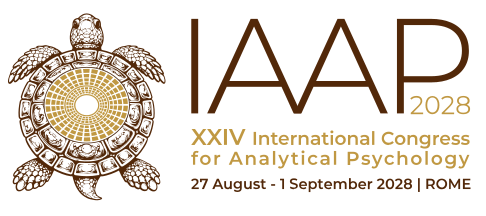
The XXIV International Congress for Analytical Psychology Logo is inspired by both the turtle and the dome of the Roman Pantheon, the temple of the Gods.
The turtle, symbol of endurance and primordial wisdom, carries its temenos upon its back. It embodies slowness in a culture of acceleration, containment in a time of fragmentation, and protection without withdrawal. Across mythologies, the turtle often supports the world itself — a living foundation beneath shifting realities.
Its shell evokes the coffered dome of the Roman Pantheon — an architectural temenos open to the sky. The oculus at the center becomes a symbolic aperture: a place where the transcendent enters the human realm, where light penetrates structure, where vulnerability meets containment.
In this image, nature and architecture merge. The living and the constructed. Instinct and culture. The archaic and the contemporary.
Call for Papers
In an era marked by wars, political polarization, ecological crisis, population displacement, technological acceleration, and a profound sense of destabilization on many levels, the analytic community is called to reflect upon the psyche’s capacity to create and sustain temenos: a protected yet permeable symbolic space in which transformation may occur. The concept of temenos, central to Jung’s understanding of the analytic container, evokes both sacred enclosure and living process.
Rome offers a compelling symbolic and historical setting for this inquiry. Layered with the remnants of empire, religious authority, artistic brilliance, violence, collapse, and renewal, Rome embodies what Jung described as the coexistence of different psychic strata within the collective unconscious. Here, the past lives palpably within the present—partly buried, partly illuminated. The city stands as a witness to history and as a bearer of opposites: sacred and profane, creativity and destruction, tyranny and liberty. Jung’s own complex relationship to Rome—his repeated intention to visit and the unconscious impediments that prevented him—invites reflection on the archetypal charge the city carries.
At a time when collective forces threaten to inundate individual subjectivity, the analytic task of witnessing, engaging, transforming becomes both clinical and cultural. In the consulting room, analysts are increasingly confronted with manifestations of trauma, political anxiety, ecological dread, and fragmentation of identity. These pressures reverberate through the earliest layers of psychic organization, affecting attachment, affect regulation, and the capacity for symbol formation. How do we engage the overwhelming without being possessed by it?
In what ways might individuation be understood as a lifelong developmental process, lived amidst relational matrices that extend across generations? How do contemporary ruptures trigger early relational traumas and how are they being inscribed in the relational experience of children?
This Congress seeks to explore the tension between historic rupture and the eternal dimension of the psyche. How do we hold vulnerability—personal and collective—without retreating into abstraction or ideological certainty? How might the teleology of individuation serve not only the individual but also the community?
The Congress location, the aesthetically stunning Auditorium Parco della Musica, is the most visited cultural building in Europe, second in the world only to Lincoln Center in New York. The Auditorium is situated in Rome’s Flaminio district which is within easy walking distance of the City’s historic center. The district itself is a major cultural hub thanks to the presence of numerous museums, theatres, and multifunctional venues, most notably the Auditorium.
From the innumerable possible sites to explore in Rome and its surroundings, the members of the Congress Local Organizing Committee, Chiara Tozzi, Antonio De Rienzo, Antonella Adorisio, Flavia D’Andreamatteo, María Paola Lanti, Vicenzo Grenci, and chaired by Luisa Zoppi, are selecting and organizing visits to those that it feels might most appeal to our diverse Jungian community. At this Congress, you will be able to experience first-hand the city that Jung described as, “the still smoking and fiery hearth from which ancient cultures spread.”
We look forward to receiving your proposal.
Additional information on accommodations, registration and related matters will be available shortly. We look forward to receiving your proposals.
With very best wishes from the Program Committee of the XXIV International Congress for Analytical Psychology
Brockton Hill, CGJLA – Los Angeles – USA, Chair
Alex Peer (CGJISF) – San Francisco – USA
Ana María Salazar (SCAJ) – Colombia
Andreas Michel (CGJIZ) – Switzerland
Fred Borchardt (SAAJA) – South Africa
Grazina Gudaite, LAAP – Lithuania
Mari Yoshikawa (AJAJ) – Japan
Monica Luci (AIPA) – Italy
Pilar Amezaga, SUAPA – Uruguay
Stacey Jenkins (OAJA) – Canada